Whether you’re a parent noticing changes in your child’s bite, a teen dealing with crowded teeth, or an adult finally ready to address long-standing concerns, knowing when to schedule an orthodontic consultation is important—but it shouldn’t feel overwhelming.
We make it easy for the whole family to have shining smiles at Clifton & Mauney Orthodontics & Pediatric Dentistry. Families throughout Chapel Hill and the greater Triangle have trusted us for decades because everything—evaluations, monitoring, orthodontics, and pediatric dentistry—is available under one roof by a team that treats you like one of our own.
When should you see an orthodontist?
Generally speaking, you should schedule an orthodontic appointment whenever you have a question about how your teeth are aligned or when you are concerned with the quality of your bite. Sometimes, such a problem is very obvious. For example, you may have crowded, misplaced, misaligned, or protruding teeth, or you may find it difficult to chew or speak properly.
Other orthodontic issues/problems are not so obvious. Some signs that could indicate that you need to see an orthodontist include:
- You regularly breathe through your mouth
- You grind your teeth routinely
- You cannot open or close your mouth comfortably
- Your jaws shift or make sounds when they move
- You unintentionally bite the inside of your cheeks
- You have facial features that are not in proportion with others
You may also need to make an emergency visit to the orthodontist. Emergency visits should be reserved for when you or your child has issues with current appliances (like braces or aligners) that have broken and/or are scratching or poking the mouth.
Do I need an orthodontist or a dentist?
Both dentists and orthodontists play important roles in your oral health, but they do different things.
Dentists
A dentist focuses on overall dental health, including cleanings, exams, cavities, and preventive care. They monitor how teeth are developing over time and often are the first to notice signs of crowding, bite problems, or jaw growth issues.
Orthodontists
An orthodontist is a dentist who has completed more specialized training focused specifically on aligning teeth and correcting bite and jaw issues. Orthodontists diagnose and treat problems like crooked or crowded teeth, overbites, underbites, crossbites, and spacing concerns using braces, clear aligners, and other orthodontic appliances.
When to bring a teen to the orthodontist
Most adolescents begin comprehensive treatment between ages 9 and 14, when:
- Permanent teeth are in
- Growth spurts support jaw correction
- Spacing or crowding becomes more noticeable
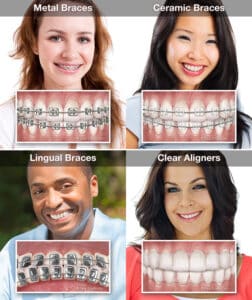
Teens today have many options if they need bite correction—metal braces, ceramic braces, clear aligners (including Invisalign and Spark Aligners).
When should children first see an orthodontist?
Our practice agrees with the recommendation made by the American Association of Orthodontists (AAO), which states that all children should receive their first orthodontic evaluation by the age of seven. By the time a child reaches this age, the bite is established so that an orthodontist can determine whether or not there will be sufficient room in the mouth to accommodate the permanent teeth. This is also when an orthodontist can spot potential problems early and treat those problems if necessary to make treatment less involved later in life and less expensive as well.
Why age 7 is the recommended milestone for an orthodontic checkup
Age seven is the ideal time for a first orthodontic visit because:
- The first permanent molars have usually erupted, establishing the back bite.
- Children have a mix of baby and adult teeth (“mixed dentition”), allowing orthodontists to identify crowding, spacing, crossbites, and eruption patterns early.
- Jaw growth is still highly adaptable, making interceptive treatments—such as palatal expansion or early bite correction—more effective.
Just because you take your child in by the time they turn seven doesn’t mean treatment will begin.
Signs your child should see an orthodontist right away
These are some common problems seen in children that can benefit from orthodontic treatment, including:
- Early or late loss of baby teeth
- A thumb or finger sucking habit
- Tongue thrusting
- Mouth breathing or airway blockage
- Jaw pain or shifting
- Loose, broken, or knocked out permanent teeth
- Spacing, crowding, or bite issues (see the picture below for more)

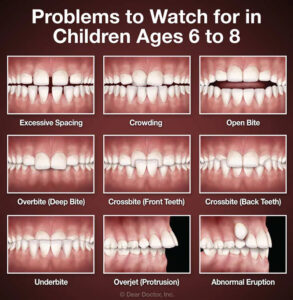
If your child has any of these problems or habits, we encourage you to schedule an appointment with our office so we can provide your child with an examination.
Additionally, if they’ve already been to the orthodontist and are having issues with braces or another appliance, bring them in right away to get it fixed.
Read More: Does My Child Need Braces?
How often will we need orthodontic visits?
- Before treatment: Monitoring every 6–12 months
- During braces/aligners: Every 4–10 weeks
- Retention (retainers): Regular checks during the first year, then annually
At Clifton & Mauney, we tailor schedules to each patient or family’s needs. We know you’re busy juggling everything else in life, and treatment shouldn’t have to get in the way. Our orthodontist in Chapel Hill is conveniently located to fit into your commute and daily lives.
Schedule your first visit today
If you’re ready to schedule your or your child’s first visit with us, just complete our online appointment form or call us at 919.933.1007. One of our friendly team members will confirm your appointment time and can give you directions to our office—conveniently located in Vilcom Center near Duke Primary Care Timberlyne off I-40 exit 266. We look forward to seeing you soon and helping you and your family achieve the amazing smiles you need and deserve!
Related Articles